Locations
Photographer at Phaselis, Antalya
Phaselis is a whole ancient city left standing in a pine wood above three small bays — ruins, forest and clear water inside one short walk, 15 km beyond Kemer.
- Couples
- Ruins & bays
- Morning light
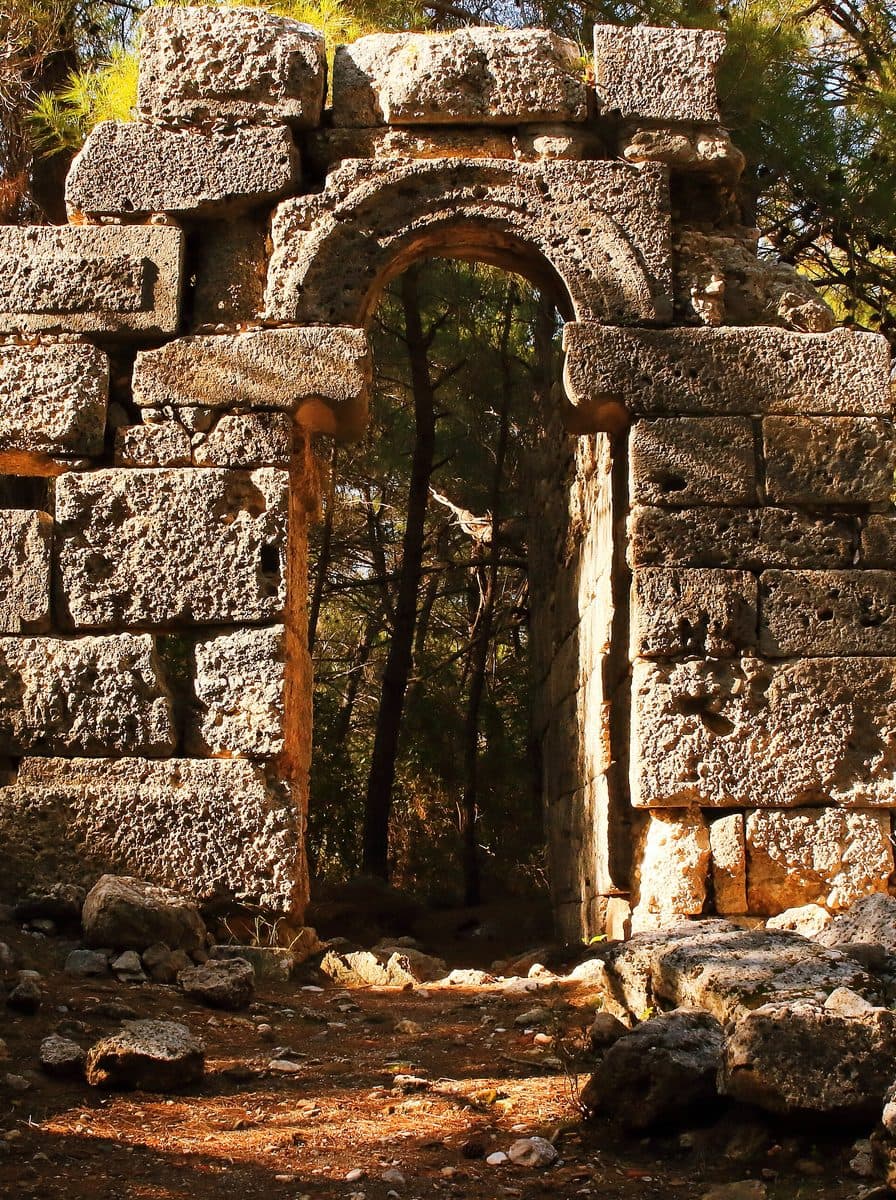
Photo: Josh.artofwayfaring · CC BY-SA 4.0
Photographer at Phaselis, Antalya
Phaselis is a whole ancient city left standing in a pine wood, with three small bays cut into the shore below it. Settlers from Rhodes founded it around 690 BC, it spent most of its working life as a Lycian port, and almost everything you can photograph today is Roman-period stone sitting on much older foundations. The site is at Tekirova, roughly 60 km down the coast from Antalya and about 15 km beyond Kemer town. Side puts a temple inside a living seaside town; Phaselis does the opposite — nobody lives here, umbrella pines grow through the streets, and the water is clear enough to read the bottom from the paving.
The backbone of the site is the colonnaded main street, a paved avenue of about 225 metres between the central and the south harbour. Be clear about what that is: the columns are largely down, so there is no standing marble here like Side’s. What you get instead is a long, straight axis lined with fallen blocks, opening onto open water at its northern end and closing on the arch of Hadrian’s Gate at its southern one — two entirely different frames from one street. Off that axis are the aqueduct arches stepping through the trees, a small theatre cut into the slope, and a scatter of thresholds, doorways and single surviving arches for closer, quieter portraits.
Phaselis faces east across the Gulf of Antalya, so the light that suits it is morning light — but how much of that morning you get is decided by the gate, not the sun. The site opens daily at 08:00; in season the ticket desk closes at 19:30 and the gate at 20:00, and from 1 November it runs 08:00 to 17:00. That rules sunrise out entirely. Antalya’s sun is up between roughly 05:30 in June and 07:30 in December, so for most of the year first light has come and gone before anyone can walk in. We plan around the first hour after opening instead, and that hour changes with the month: in November and February 08:00 sits close to first light and the low angle off the water is exactly right, while in July the sun is already high and we work the shade lines under the pines and the colour of the water rather than a glow on the stone.
The evening needs the same honesty. The ridge behind the bays — Tahtalı rises to 2,365 m a few kilometres inland — takes the sun long before it reaches a sea horizon, so the sinking-into-the-water frame that Side and Konyaaltı deliver does not occur here. In high summer the schedule compounds it: the desk shuts at 19:30 and the gate at 20:00, before the sun is anywhere near down. If sunset is your reason for booking, we finish on the open public shoreline at Tekirova just outside the entrance, minutes from the car park.
Phaselis is a ticketed Ministry of Culture archaeological site rather than an open piece of town, and that is the thing to know before booking. Entry is €10 per person for foreign visitors, collected at the gate in lira at the day’s rate, and free for Turkish citizens holding a Müzekart; if you plan to keep coming back for the bays there is a Phaselis Pass at €60 for ten entries and a local card at ₺180 for five or ₺280 for ten. That ticket is paid to the site, not to us — your package price does not move — but you should meet the number here rather than at the barrier. Separately, photography at a Ministry ören yeri beyond ordinary visitor snapshots is formally covered by a permit letter from the Antalya provincial culture and tourism directorate, and no price for one is published anywhere. That is why we keep sessions at visitor scale: handheld, no lighting stands, no staging, no drone. If you want more — a full bridal gown, a tripod, an event — tell us early enough that we can ask before your date instead of on it.
A session here is a walk rather than a stand. The site runs about a kilometre end to end and everything worth shooting sits along that line, so we open on the colonnaded street while it is still quiet, take the aqueduct and the theatre next for height and texture, then drop to whichever bay is emptiest to finish at the water. Jane meets you at the entrance with the kit and walks the route with you — no vehicles inside, no transfers between stops, just the walk. Give us the name of your hotel in Tekirova, Kemer or anywhere along this stretch, and the order of the stops gets built backwards from your start time.
Couples and honeymoon sessions get the most from it because the scale does the work — standing still in the middle of an empty city is already a photograph, and nobody has to perform. Engagement and anniversary shoots land the same way. Solo portraits belong at the theatre and in the shaded doorways, where one person reads against the stone instead of disappearing into a wide view. Families get an advantage an ancient site does not usually offer: the south bay is sand and genuinely swimmable, so a child can be in the water while the adults finish a set. A flying dress opens well along the fallen colonnade with water behind it, and better still inside one of the surviving arches, where the fabric gets a frame to move against.
Footwear deserves a thought. You are on ancient paving, pine roots and loose stone rather than pavement, and the three bays differ underfoot: the south bay is sand, the north bay is pebble, the middle one shallow with stone at the edge. Flat shoes with grip handle all three; sandals are good at the water and awkward on the paving. The pines give real shade along most of the route, which makes a mid-morning session in August far easier here than on an open beach, but bring water regardless, and a towel if anyone means to swim. There is nowhere among the ruins to change properly, so if you want two looks, plan a second that goes over the first rather than replacing it.
Against Kemer, fifteen kilometres back along the same road, the register is entirely different: Kemer is a marina, a resort beach and a working town, while Phaselis is an empty city in a forest with nothing being sold at the edge of the frame. Against Side, the ruins are smaller, more scattered and more overgrown, but the sea begins immediately behind the stones instead of beyond a promenade. On packages: Mini at $39 buys thirty minutes, one setting and twenty-five edited photos, realistically the colonnaded street alone. Classic at $79 gives an hour, two settings and fifty photos — street plus a bay. Premium at $109 runs two hours, three settings and seventy photos, and here the third setting usually goes to the shoreline outside the gate, for the light the site closes before. Flying-dress rental is $20 on any package, an extra location $12, priority delivery in four days instead of the standard week $15. Message WeCare Photoshoot on WhatsApp at +90 551 086 83 68 with your dates and hotel — Jane replies in English, Russian or Turkish, usually within the hour, nothing is paid while dates are still being settled, and a small deposit holds the slot once it is agreed.
Other locations we shoot in Antalya
- Kaleiçi Old TownKaleiçi is Antalya’s most photogenic corner — cobblestone lanes, Ottoman houses and bougainvillea at every turn.
- Konyaaltı BeachKonyaaltı beach pairs turquoise water with the Taurus mountains — Antalya’s most iconic beach backdrop.
- Lara BeachLara beach offers wide golden sand and space to move — ideal for families and playful sessions.
- Düden WaterfallsDüden is where a waterfall drops straight into the sea — dramatic, misty and unforgettable.
- KemerKemer is where the pine-covered Taurus mountains drop straight into the turquoise sea — a dramatic, green-and-blue backdrop 40 minutes west of Antalya.
- BelekBelek is Antalya’s luxury resort strip — manicured golden beaches, palms and five-star terraces made for relaxed, elegant photos.
- SideSide pairs ancient ruins with the sea — the marble columns of the Temple of Apollo at sunset are one of the whole coast’s most striking backdrops.
- Kurşunlu WaterfallKurşunlu is our inland set — a ticketed nature park in Aksu where the shade never breaks and the best hour is the one we tell you to avoid on the sand.
- Göynük CanyonGöynük Canyon is a wooded limestone valley in the mountains behind Kemer, about 35 km from Antalya — pine shade, a gravel track beside a stream, and not a single glimpse of the sea.
- AspendosAspendos is a Roman theatre that survived almost whole — a stage wall still standing at full height, tiers of warm limestone, and the Taurus foothills behind the top row.
- ÇolaklıÇolaklı is the resort shoreline west of Side — no monument, no gate and no opening hour, just wet sand that mirrors the sky at both ends of the day.
Good questions, honest answers
Do we have to pay to get into Phaselis?
Yes — €10 a head for foreign visitors, taken at the gate in lira, and free for Turkish citizens on a Müzekart. That money goes to the site rather than to us, so your package price does not move. It is not the only gate we shoot behind, either: Aspendos charges €15 and Kurşunlu around ₺95 per adult. Budget the day around the location you actually pick.
Can we shoot at sunrise at Phaselis?
No. The gate opens at 08:00 all year, and Antalya’s sunrise runs from about 05:30 in June to about 07:30 in December, so the sunrise slot people ask about does not exist inside the site. The first hour after opening is the closest we can get, and in late autumn and winter that hour is genuinely low and warm. If you specifically want first light, we shoot it on an open public beach instead, where there is no gate to wait for.
Is a permit needed to photograph there?
For a handheld session at visitor scale, no — which is exactly why we shoot Phaselis that way. The line is set-up time. A tripod, lighting, a full bridal gown or anything event-shaped crosses into permit territory. The letter comes from the Antalya provincial culture and tourism directorate, its price is published nowhere we can find, and we are not going to invent one for you. We make the request, but it has to go in weeks ahead rather than days. If the answer has not arrived by your date nothing is cancelled: we keep the ruins at visitor scale and take the gown down to the open Tekirova shoreline outside the entrance instead.
Which package suits Phaselis best?
Classic is the honest default: an hour and two settings covers the colonnaded street and one bay without rushing either. Mini works if the street is all you want. Premium makes sense when you want the third setting on the shoreline outside the gate, which is where the end-of-day light actually happens here.
How far is Phaselis, and do you travel out there?
It is at Tekirova, roughly 60 km along the coast from Antalya and about 15 km past Kemer town. Jane travels out with all the equipment and meets you at the site entrance, or at your hotel first if that is simpler. Send us where you are staying on WhatsApp and we will agree the meeting point when we confirm the time.
Ready for photos you’ll love forever?
Send your dates — we’ll handle the light, the spots and the smiles.